
9 Signs of Termites in Your Melbourne Home: What to Look For

Keep Your Property Ant-Free with Professional Ant Pest Control in Melbourne
September 19, 2026
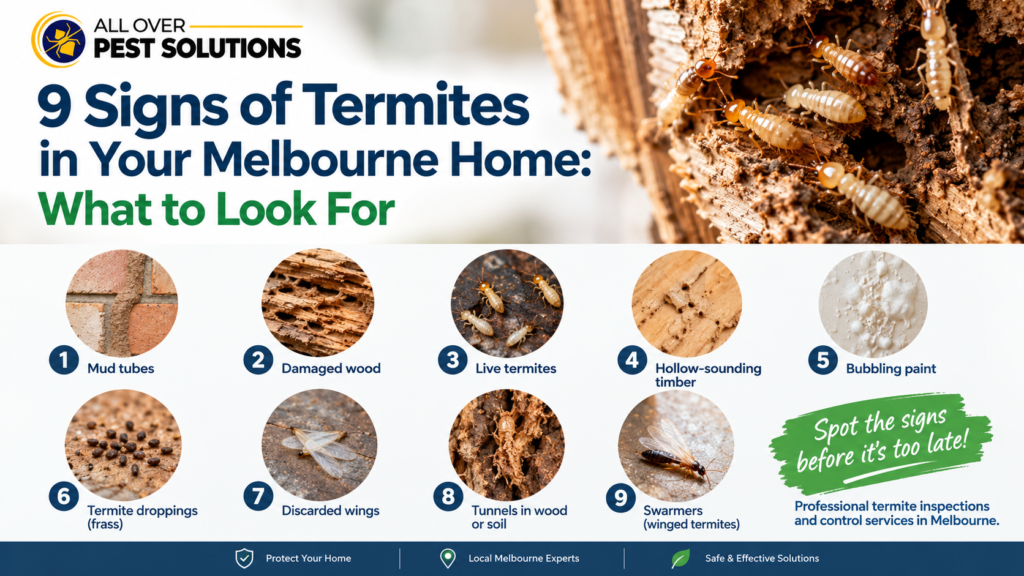
Think you may have termites in your home? Termites can be difficult to detect because activity may occur inside timber, wall cavities, subfloors or other concealed areas. Some warning signs are visible, while others may only become apparent during a professional inspection.
Common indicators include mud tubes, damaged or hollow-sounding timber, discarded wings, changes around damp areas and other signs of termite activity.
If you notice one or more of these signs, avoid disturbing the affected area and consider arranging a professional termite inspection in Melbourne.
1. Mud Tubes or Mud Leads
One of the more recognisable signs of subterranean termite activity is a mud-like tube or trail.
These structures may appear around:
- foundations
- external walls
- brickwork
- timber structures
- subfloor areas
- service penetrations
- other potential entry points
Termites can use these protected pathways to move between their nest and a food source.
The Victorian Building Authority advises homeowners to look for mud-like tubes or material around external footings and brickwork, as well as around internal fittings such as service pipes and electrical plugs.
If you find a suspected termite tube, don’t automatically assume that removing it has solved the problem. The visible sign may only represent part of a larger infestation.
For suspected activity, an inspection can help determine whether termites are active and whether further treatment is required.
2. Timber That Sounds Hollow
Another potential warning sign is timber that sounds unusually hollow when gently tapped.
Termites can consume timber internally, meaning the outside surface may initially look relatively normal.
Possible areas to check include:
- skirting boards
- door frames
- window frames
- exposed structural timber
- timber flooring
- other accessible wooden components
A hollow sound alone does not prove that termites are present. Timber can become hollow or damaged for other reasons, including decay.
That is why suspected termite damage should be assessed alongside other evidence.
3. Damaged or Weakened Timber
Termite-damaged timber may become weak, brittle or easier to break.
The Victorian Building Authority identifies weakened timber and wafer-thin layers as possible indicators of termite activity.
You may notice:
- timber breaking more easily than expected
- damaged edges
- surface deterioration
- weakened skirting
- unusual timber movement
- areas that appear damaged internally
Do not remove large sections of potentially affected timber simply to investigate.
A professional inspection can help establish the extent of the problem before unnecessary disturbance occurs.
4. Discarded Termite Wings
Winged termites can leave their colonies during reproductive flights.
Afterward, discarded wings may sometimes be found around:
- windows
- doors
- light sources
- floors
- window sills
Finding wings does not necessarily mean termites are currently feeding inside the building, but it can be an important reason to investigate further.
This is particularly relevant when discarded wings are found together with damaged timber, mud tubes or other signs.
5. Cracks, Holes or Fine Residue Around Timber
Small cracks, holes or unusual fine material around timber or plaster can have several possible causes.
However, when these signs appear alongside other indicators of termite activity, they deserve attention.
The Victorian Building Authority recommends looking for cracks or holes in timber or plaster accompanied by fine dust-like residue.
Because different building defects and timber pests can create similar symptoms, identification should not be based on one sign alone.
6. Blistering Paint or Changes to Walls
Changes to painted or finished surfaces can sometimes indicate a problem underneath.
You may notice:
- blistering paint
- bubbling surfaces
- unusual discolouration
- minor distortion
- damaged skirting
- unexplained changes around timber
These symptoms are not specific to termites. Moisture, plumbing problems, timber decay and other building issues can create similar appearances.
For that reason, a proper assessment should consider both pest activity and building conditions.
7. Moisture-Prone Areas Around the Property
Moisture does not automatically mean termites are present, but damp conditions can create conditions that deserve attention during termite risk assessment.
Check areas such as:
- leaking plumbing
- poorly drained areas
- damp subfloors
- garden beds close to the structure
- timber close to soil
- areas where water collects
When assessing a property, it’s useful to consider not only whether termites are present but also what conditions may make the property more vulnerable to future activity.
8. Signs Around Trees, Timber and Garden Areas
Don’t only inspect the house itself.
The Victorian Building Authority recommends checking surrounding trees, wood piles and garden beds for signs of termite activity.
Pay attention to:
- old tree stumps
- stored timber
- timber landscaping
- garden beds close to the building
- damaged outdoor timber
Finding termite activity outside the building does not automatically mean the house is infested.
However, it can be a reason to have the property assessed, particularly if there are accessible pathways between the surrounding area and the structure.
9. You Keep Finding Signs You Can’t Explain
Sometimes the first warning isn’t an obvious termite tube or damaged timber.
It may simply be a combination of unexplained observations:
- repeated timber deterioration
- unusual marks
- discarded wings
- moisture problems
- damaged garden timber
- changes around skirting or frames
When several signs occur together, getting a professional assessment can help distinguish termite activity from ordinary building maintenance issues.
Can You Have Termites Without Seeing Them?
Yes.
One of the challenges with termites is that activity can occur in concealed areas.
Termites may be active inside or beneath parts of a building without producing obvious signs that a homeowner can immediately recognise.
The Victorian Building Authority specifically notes that termite activity is often difficult to detect because it can occur in concealed areas.
That is why visual checks are useful but shouldn’t be treated as proof that a property is termite-free.
If you’re concerned about possible activity, an appropriate termite inspection can provide a more informed assessment.
What Should You Do If You Find Termites?
If you discover suspected termite activity, avoid taking actions that could unnecessarily disturb the affected area.
In particular, don’t rely on ordinary surface insect sprays as a solution to a suspected termite colony.
The Victorian Building Authority advises homeowners who find termites to engage an approved pest controller and warns against using surface spray or removing affected building materials before professional assessment, because disturbing visible termites can make it harder to locate and treat the main colony.
Instead:
- Take photographs of the signs if possible.
- Note where and when you found them.
- Avoid disturbing the affected area.
- Check for other visible signs around the property.
- Arrange an appropriate termite assessment.
When Should You Book a Termite Inspection?
Consider arranging an inspection if you:
- find suspected termites
- discover mud tubes
- find discarded termite wings
- notice unexplained timber damage
- are concerned about moisture and timber conditions
- have found termite activity around the property
- are purchasing a property
- want to understand the property’s termite risk
All Over Pest Solutions provides termite control and inspection services across Melbourne and the Victoria region, with services for residential and commercial properties. The company’s termite service information describes inspection, identification, assessment and treatment as part of its approach.
What Happens During Termite Control?
Termite management should be based on the conditions identified at the property rather than assuming every infestation requires exactly the same treatment.
All Over Pest Solutions explains that its termite services assess signs of activity, consider the condition of the property and recommend an appropriate management approach.
Depending on the property and findings, termite management may involve treatment, prevention measures and ongoing monitoring.
You can learn more about the service on our Termite Pest Control..
Can Termites Be Prevented?
No prevention measure can guarantee that a property will never experience termite activity.
However, reducing favourable conditions and maintaining awareness can help.
Practical steps include:
- address persistent moisture problems
- maintain drainage
- keep inspection areas accessible
- avoid unnecessary timber-to-soil contact
- monitor timber around the property
- check garden structures and stored timber
- arrange inspections where appropriate
Our Termite Protection Barriers service provides additional information about termite protection options.
Buying a Melbourne Property? Consider a Pre-Purchase Termite Inspection
If you’re buying a property, discovering termite activity after settlement can create an unpleasant and potentially expensive problem.
A pre-purchase termite inspection can help identify signs of termite activity, damage and risk conditions before you commit to the property.
The Victorian Building Authority recommends having an expert inspect a property for termite activity before buying and advises buyers to engage a properly qualified, experienced and insured pest inspector.
All Over Pest Solutions provides Pre-Purchase Termite Inspections across Melbourne and Victoria.
You can also explore our Pre-Purchase Building & Pest Inspections service if you want a broader property assessment.
Frequently Asked Questions
What is the first sign of termites?
There isn’t one universal first sign. Mud tubes, discarded wings, weakened timber and other unexplained timber or building changes can indicate termite activity. Because termites can remain concealed, a professional inspection may be appropriate when signs are suspected.
How do I know if my house has termites?
Look for mud tubes, discarded wings, weakened or damaged timber and other unusual signs around timber, foundations and moisture-prone areas. No single sign confirms an infestation, so suspected activity should be professionally assessed.
Can termites damage a house without being seen?
Yes. Termite activity can occur in concealed areas, making it possible for damage to develop before homeowners notice obvious evidence.
Are termites only found in old houses?
No. The age of a property alone does not determine whether termites can be present. Construction, moisture, access points, surrounding conditions and termite management measures all matter.
Should I spray termites myself?
Don’t rely on ordinary surface insect spray as a solution to suspected termite activity. Disturbing visible termites can interfere with professional assessment and treatment. If you find suspected termites, arrange an appropriate inspection.
Do I need a termite inspection before buying a house?
A pre-purchase termite inspection can help identify termite activity, damage and relevant risk conditions before purchasing. The Victorian Building Authority recommends expert termite inspection before buying a property.
How often should a property be inspected for termites?
The appropriate inspection frequency depends on the property, construction, previous termite history, site conditions and other risk factors. A pest professional can advise on an appropriate monitoring approach for the property.
Need Help With Suspected Termites in Melbourne?
If you’ve noticed mud tubes, damaged timber, discarded wings or other possible signs of termite activity, don’t wait until the problem becomes obvious.
All Over Pest Solutions provides termite inspection, termite control and termite protection services for residential and commercial properties across Melbourne and the surrounding Victoria region.